Brendan Lynskey, home page: BL-1994 · Staff engineer Datasheet · Rev 2026.10 · LEEDS, UK Active

For Optalysys

Computing with light: encryption and AI

Optalysys works on optical computing, including for fully homomorphic encryption. These are the sites, decks and simulators I built to learn the areas that work touches: the optics, encrypted computing, AI workloads, and how to simulate all three.

sourcemodulators4-point optical DFTreceiversread-outlaserlocal oscillator, from the same laserbits ↓x0x2x1x3−jX0X2X1X3stage 1stage 2crossingexact modePAM4 slicers + table→ exact integersNTT, FHEapproximate modeADCs→ a few bitsFFT- and AI-style
Illustration, as the simulator models it: one laser feeds four modulators driven by bits, and a local oscillator. A two-stage mesh of 2×2 couplers, a −j phase shifter and one crossing computes a 4-point DFT in one pass; coherent receivers read it. In exact mode the levels decode to exact integers (NTT, FHE); in approximate mode ADCs keep a few bits (FFT- and AI-style work). The real layout is not published.

I built all of this for my own learning, and I am still working my way through it. Each page below says what it does and why I made it. They follow one path: the hardware, the workloads it might run, and the engineering that makes a simulator's answers trustworthy.

The hardware

How light computes, from the device physics up to a whole module, modelled in enough detail to ask whether it pays.

Interactive site · 17 chapters, simulator in the page

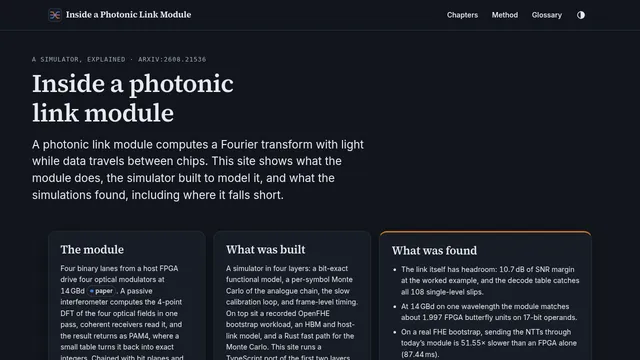
Inside a Photonic Link Module

What it doesA simulator of a photonic link module (arXiv:2608.21536), explained chapter by chapter: the modulators, the optical Fourier transform, homodyne detection, calibration, and how a 4-point kernel becomes an NTT inside a real FHE bootstrap. A TypeScript port of the simulator runs in the page, checked against the Python reference. Part II models a future chip with the photonics stacked on its logic.

Why I built itTo understand the hardware properly by modelling it, layer by layer, and to see with numbers where it pays and where it falls short.

Open the site (Inside a Photonic Link Module)Method (Inside a Photonic Link Module)
Deck series · 3 decks

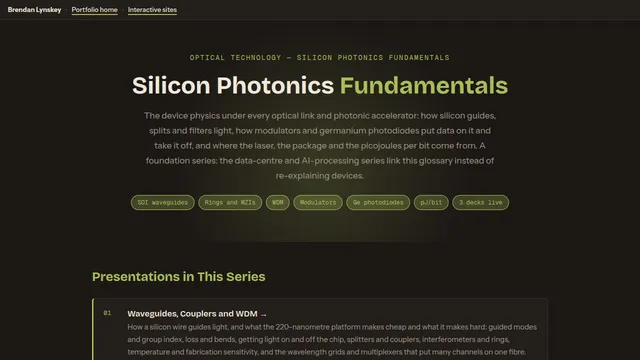
Silicon Photonics Fundamentals

What it doesThe device physics under every optical link: how silicon guides, splits and filters light; how modulators and germanium photodiodes put data on it and take it off; and where the laser, the package and the picojoules per bit come from.

Why I built itMy background is electronics. This is the optics I needed underneath everything else.

Open the hub (Silicon Photonics Fundamentals)

The workloads

What the optics might be asked to do: encrypted computing, and moving and transforming data for AI.

Deck series and simulator · 5 decks, tested code

FHE Accelerator Simulators

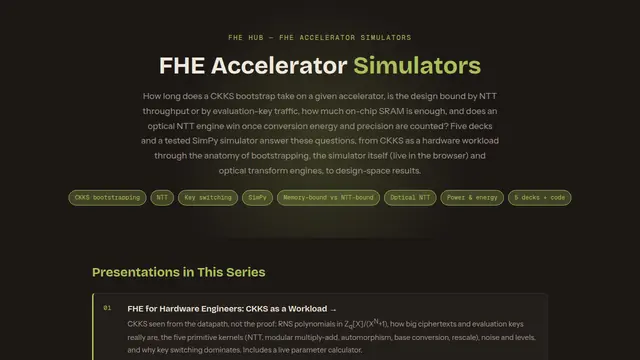
What it doesCKKS as a hardware workload, the anatomy of bootstrapping, a SimPy simulator of an FHE accelerator (live in the browser), optical NTT engines, and the design space: is a design bound by NTT throughput or by key traffic, and does an optical NTT engine win once conversion energy and precision are counted?

Why I built itTo learn FHE from the hardware side: where an accelerator spends its time and energy, and where optics could help.

Open the hub (FHE Accelerator Simulators)The simulator (FHE Accelerator Simulators)

Deck series and results site · 5 decks, an experiment

Compute in Transit

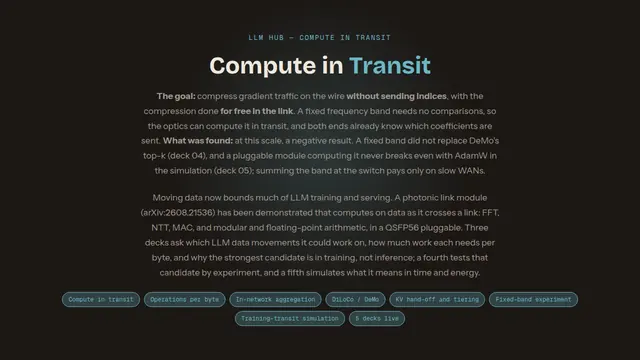
What it doesWhich data movements in LLM training and serving a photonic link module could compute on as the data crosses the link, how much work each needs per byte, and an experiment on the strongest candidate: a fixed frequency band in place of DeMo's top-k for compressing gradients. At this scale the answer is no, and the results site shows why.

Why I built itTo find out whether the module could help AI training, by experiment rather than by argument.

Open the hub (Compute in Transit)The results site (Compute in Transit)

Deck series · 5 decks

Fourier Optics for Inference

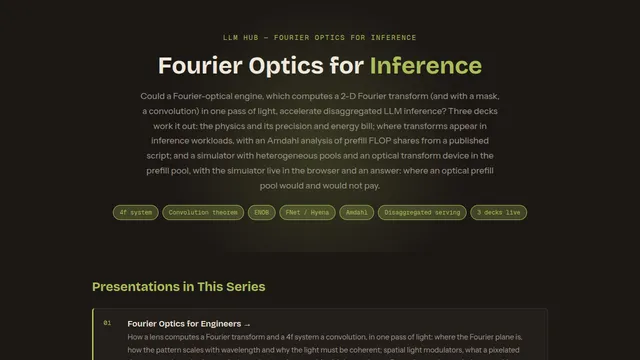
What it doesCould a Fourier-optical engine accelerate LLM inference? The physics with its precision and energy bill, where transforms appear in inference workloads, a disaggregated-serving simulator with an optical transform device in the prefill pool, the photonic link's hardware, and which AI workloads the future stacked chip could run.

Why I built itTo put numbers on where optical transforms could matter for serving AI models, and to test the AI case for the stacked chip against its simulated precision and energy.

Open the hub (Fourier Optics for Inference)AI workloads deck (Fourier Optics for Inference)

Deck series · 3 decks

Fourier Optics for Training

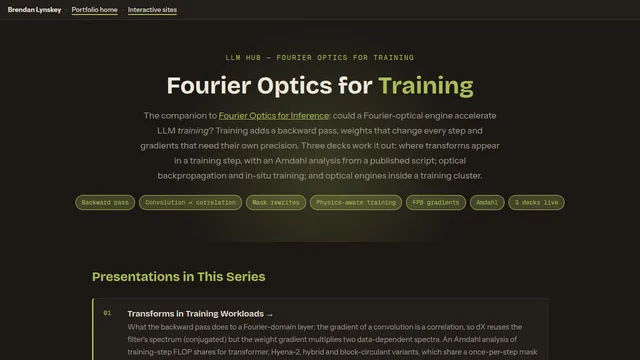
What it doesThe companion question for training: transforms in the backward pass, optical backpropagation and in-situ training, and optical engines inside a training cluster.

Why I built itTraining is a different problem: the weights change every step and the gradients need their own precision.

Open the hub (Fourier Optics for Training)

The simulation engineering

The craft around a simulator: the code, tests, pipelines and measurements that make its answers trustworthy.

Deck series · 14 decks, each with tested code

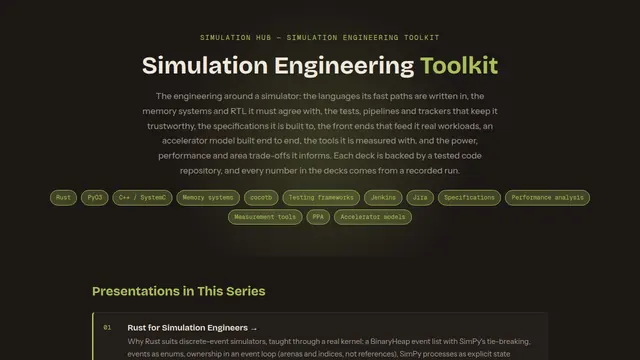
Simulation Engineering Toolkit

What it doesRust and PyO3 fast paths, SystemC models, memory systems, cocotb against RTL, testing frameworks, Jenkins, specifications, PyTorch and ONNX front ends, performance analysis, measurement tools, power-performance-area trade-offs, and an accelerator model in SimPy end to end. Every number in the decks comes from a recorded run.

Why I built itThese are the everyday tools of simulation and frameworks work. I built a deck and working code for each to practise them.

Open the hub (Simulation Engineering Toolkit)

Presentation · one interactive deck

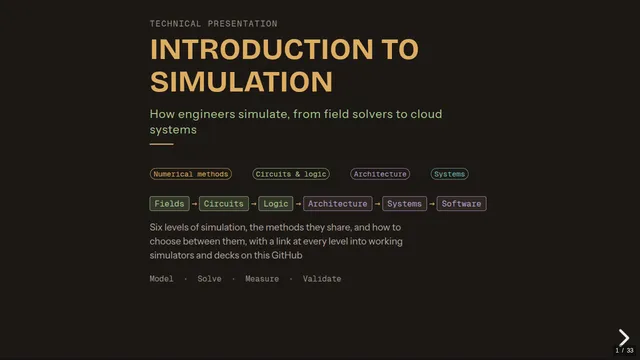
Introduction to Simulation

What it doesSix levels of simulation, from field solvers to cloud systems, the methods they share and how to choose a level, with links at every level into working simulators and decks.

Why I built itTo place the module, the FHE accelerator and the rest within simulation as a whole.

Open the deck (Introduction to Simulation)

Sources

The material rests on these: the module's paper and patents, its developer's public talks, and the encryption and AI work it builds on. Each line says where it is used.

The module

Patents

Talks and public statements

Encryption and AI foundations

The rest of my work, from signal integrity to agentic AI, is in the portfolio, and my experience is in the CV.